
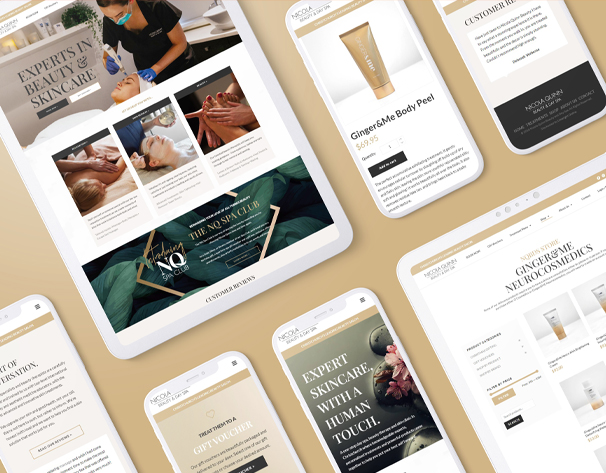
Wellness websites have a slightly different job.
They still need to look professional, explain the offer and guide people towards the next step, but there is often more emotion sitting underneath the decision.
Someone might be looking for support with stress, skin, movement, recovery, confidence, hormonal health, bodywork, massage, nutrition, therapy or a more grounded way to feel better in themselves.
That person is not just comparing prices and appointment times. They’re checking whether the business feels safe, credible and like the right kind of support.
A wellness website needs to hold that decision carefully.
The short version
A trustworthy wellness website feels clear, calm, specific and easy to navigate. It explains what you offer, who it is for, what the experience feels like and how someone can take the next step.
Trust comes from the combination of good design, clear copy, real photos, thoughtful service information, proof, qualifications where relevant and a client journey that feels simple to follow.
No mysterious wellness fog, please. Calm can still be clear.
Trust starts with clarity
A wellness website can be beautiful and still feel unclear.
Soft colours, calming imagery and gentle language are all lovely, but they need to be supported by useful information.
People should be able to understand what you offer, who it is for, where you are based, whether appointments are online or in person, and what the next step looks like.
If someone has to guess what the service actually involves, trust becomes harder.
Clear does not mean cold. It means the person reading does not have to work too hard to feel oriented.
Your copy should explain the experience
Wellness businesses often rely on feeling, and that makes sense. The experience matters.
But your website still needs to explain the practical side.
What happens in the first appointment? How long does it take? Is there a consultation? What should someone wear, bring or prepare? Who is the service best suited to? Is it gentle, active, therapeutic, educational, relaxing, structured or intuitive?
Those details help people picture themselves in the experience.
They also reduce uncertainty, which is a big part of trust.
Photos should feel real and grounded
Real photos are especially useful for wellness businesses.
People want to see the space, the practitioner, the treatment room, the details and the feeling of the environment before they arrive.
They do not need every corner of the room documented. They just need enough to feel like they know what they’re walking into.
A project like 23 Therapies shows how a wellness website can use a calm visual direction to help the business feel grounded and approachable.
If your website relies heavily on stock imagery, it can feel a little removed from the real experience. Stock can be useful in small amounts, but the human details matter.
Service pages need to answer the quiet questions
People often have questions they will not ask straight away.
They may wonder whether the service is right for them, whether they will feel comfortable, whether they need to talk during the appointment, whether it will hurt, whether they need to be experienced, or whether the practitioner will understand their situation.
Your website can answer some of those questions gently.
A good service page explains who the service is for, what the session involves, what someone can expect and how to book or enquire.
This is not about over-explaining everything. It is about removing enough uncertainty that someone feels safer taking the next step.
Trust is built through specifics
Vague wellness copy can start to sound the same from one website to the next.
Words like calm, balance, healing, support and transformation can be useful, but only when they are backed up by specifics.
What kind of support do you offer? How do you work? What does your process look like? What makes your approach different? What kind of clients do you help most often?
The more specific the website is, the easier it is for the right person to feel understood.
This is also where your About page can help. If that page is feeling a bit too much like a life story and not enough like useful context, Why your About page should still be about your client will be worth reading next.
Proof does not have to feel loud
Wellness proof can be subtle.
It might be testimonials, client words, qualifications, years of experience, referral sources, product brands, professional memberships, case studies or a clear explanation of your process.
You do not need to shout about every credential from the top of the page. But people should be able to see why they can trust you.
For some wellness businesses, testimonials are especially powerful because they show how people felt before, during and after working with you.
Those details can help a potential client feel less alone in their decision.
The design should support calm, not hide information
A calm website is not the same as an empty website.
Whitespace, soft colours and simple layouts can be beautiful, but they still need to support the content.
If everything is too minimal, people may not get enough information to feel confident. If everything is too full, the website can feel overwhelming. The balance matters.
For wellness websites, I usually want the design to feel easy to move through. Clear sections, readable copy, thoughtful imagery, obvious buttons and enough breathing room that the experience feels considered.
Basically, calm with a job to do.
The booking or enquiry pathway should feel gentle and clear
Not every wellness service is a direct “Book now” decision.
Some people need to ask a question first. Some need a consultation. Some need to understand the approach before they feel ready. Some are ready immediately and just need the button to be easy to find.
Your website should support those different decision stages.
You might use “Book a session”, “View services”, “Book a consultation”, “Send an enquiry” or “Start here”, depending on what the client needs to do next.
The wording should feel clear without feeling pushy.
A trustworthy website makes the next step feel easier
A good wellness website helps someone feel less unsure.
They understand what you offer. They can picture the experience. They know whether it feels right for them. They trust that you know what you’re doing. They can see the next step.
That is the work the website is there to do.
If your wellness website feels lovely but a little unclear, it may need stronger structure, more specific copy or a smoother pathway into booking.
Website in a Week is designed to help service businesses create a clearer, more strategic website without dragging the process out for months.
You can view the Website Design page, or submit a project enquiry if you’re ready for a website that feels trustworthy, useful and easy to move through.

